To many, the Saturday gig is church.
It’s a CBD bar at roughly ten pm. A community gathers, each member guided by common purpose. Hands grasp. Vapes pulled. Word on the street is that tonight’s act is going to be huge.
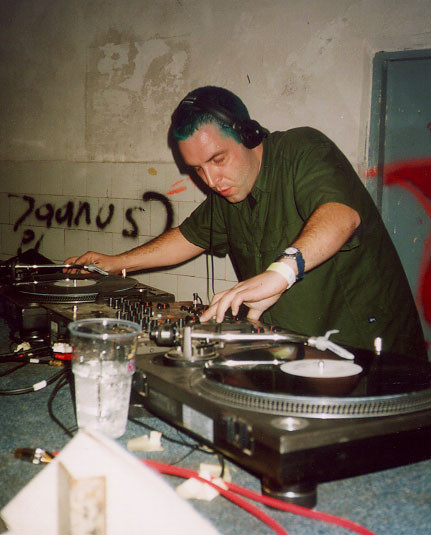
A heavy bassline reverberates from a set of monolithic speakers. They flank headphones nestled amid dreadlocks. A figure surveys what looks to be the controls to a rocket ship – they aren’t, they’re mixing decks, but he’ll nevertheless send his passengers to space.
Outside, in the alleyway, a psych major makes half a cigarette disappear in one pull before his mates’ bewildered eyes. It’s a double-bill demonstration of vitality and sheer will. Soon after, they head inside. The gig’s about to begin.
Each devotee stands shoulder to shoulder before their pastor. They face forward, atop a peak of euphoria, hands raised to heaven. The scene mirrors a similar gig the week prior, and the weekend before that. It’s a sight reminiscent of Sunday service, although with more E-cigarettes.
Drum and bass’s connotations with organised faith are many. It’s spawned an avid, mobile collection of converts that gather weekly. Each initiate seems as devoted as the last, showcasing their membership to the convent through online posting, branded clothing, and tattoos. Gareth Heta, radio DJ, music writer, and self-described drum and bass nerd, has described it like this: a community.
Community, let alone culture, is something Christchurch residents are desperate to bring back to their central city. Over the past twenty years, the provincial town has been the scene of two out of four national tragedies. Naturally, many are eager for Ōtautahi to be the epicenter of something else for a change.
Christchurch is informally hailed as having the highest per capita drum and bass (known colloquially as DnB) listenership in the world. When I told Gareth Heta this somewhat unbelievable statistic, he nodded his head. “That sounds about right,” he tells me.
Right now, according to Heta, DnB is experiencing a massive resurgence in popularity, fueled by a young and devoted crowd of students.
DnB has flowered from a long evolutionary tree, the roots of which draw from hip-hop, raga, and dub. As a genre, it’s difficult to trace, a difficulty is partly due to mixing – the process of combining two songs to make a third, unique track. To Heta, the technological aspect has
bestowed upon DJ’s the capacity to innovate and experiment in ways few other artists can.
This notion is demonstrated by DnB’s diversity. From the raucous heavy drops of jump-up to the warm, analog tones of liquid; each sub-genre denotes a wildly different sound and scene.
“Drum and bass popularity comes in waves,” says Heta, explaining to me that the previous wave crested with artists like Pendulum and Ed Rush. He continues on a whistle-stop tour of the genre’s history, explaining that this first wave ended as a result of artists becoming more popular and losing their unique sound. “In shifting towards the mainstream, they abandoned the filth and lost that underground vibe that I think people just relate to.”
Set to a rolling pace of 160-180 beats per minute, the genre’s aggressive, ominous tones construct notable barriers to entry for the uninitiated. If DnB were a religion, then the “filth” Heta mentions would be its first commandment. It’s an underground, grimy, bassface-inducing sound that separates most DnB from mainstream electronica. In short, DnB is a fast-paced genre that goes hard. To Heta, it’s electronica’s answer to heavy-metal.
Like heavy-metal, DnB tends to attract blue-collar crowds. This tendancy could reveal why Christchurch, of all cities, is New Zealand’s unnoficial DnB capital. Since large portions of the city were flattened in it’s infamous 2011 earthquake, Christchurch’s construction industry bloomed, attracting tradespeople from all over the country.
“Tradies love a bit of DnB ” says Christie Kimble. Christie, Jamie Moir, and Ashleigh Rangi are co-founders of Sub180 entertainment, a local DnB promoter. All three have been organising music events in Christchurch since the age of 15. They know their way around the scene like few others my age.
Big drops and foghorns aside, drum and bass isn’t entirely devoid of warmth. By adding more vocals and adopting a distinctly analog sound, liquid DnB emerged as an answer to the grime. Artists like DJ Fresh pioneered this sound and soon found a temporary home on the charts. Today, artists like Hybrid Minds carry the torch.
In many ways, liquid brought the genre out of the basement and into the sun. It’s whittled down the initial barriers to entry that put off those averse to dirty drops, foghorns, and big wops.
Nevertheless, it’s DnB’s inherently grimy sound and scene that has led to the development of stereotypes.
Like all labels, these consist of an awkward mix of fact and fiction. Tom Prayoonyuang, a founding member of the Christchurch-based DnB duo Catch 22, argues this: “the biggest misconception about DnB is that everyone just gets on the gear.” “I think it’s easy to slap that druggy stereotype on young people going to gigs” adds Ashleigh. “If you look at every professional industry there are people doing drugs. That gearhead stereotype ends up tainting our culture and I don’t think it’s entirely fair.”
Ashleigh has a point. Recreational drug use isn’t exclusive to DnB enthusiasts. “Just look at Woodstock or Pink Floyd,” says Jamie, “I think there’s definitely a correlation, but that doesn’t necessarily mean there’s causation.”
Nevertheless, the sordid marriage between substances like MDMA and music like EDM is well known. In the latter half of the 20th century, the mainstream appeal of both developed simultaneously. Does ecstasy make music better? Or does music make ecstasy better? Maybe both, it’s hard to tell. EDM’s open, community-centric ethos could be the result of a younger crowd that holds tolerance in higher esteem than generations prior. Or, it could result from the effects of MDMA, which makes one more social, intimate, and accepting.
Dr. Rick Doblin, the founder of the Multidisciplinary Association of Psychedelic Studies, noted in 2013 that it’s hard to determine what functions within the EDM scene are served by substances or by the pulsing beat, lights, and crowd. Ultimately, he describes the communal dance party as a spiritual experience with a blurred line separating the euphoria-inducing chemicals produced naturally by the brain and those sold by the gram.
It’s here, again, that the unlikely crossover between faith and DnB re-emerges. To Doblin, ecstasy-fueled EDM and religion serve the same two psychological purposes. They’re rituals that connect us to others, and they enable us to experience a heightened consciousness. Both qualities are present at the Saturday gig, neither appear inherently negative.
Nevertheless, both Gareth Heta and Rene Bell, owner of the popular gig-hosting venue ‘The Slate Room,’ agree that there are dangers posed by substances. This is particularly true when their usage mixes with a distinctly kiwi binge culture that prioritises “going hard” on a night out. In many ways, the electrifying pace provided by DnB fuels this impulse, thus creating a positive feedback loop of chemicals and music.
To Rene, this cocktail is enough to set business owners, such as those of the now-closed Winnie Bagoes nightclub/pizzeria, on edge. “I don’t think drugs will ever go away,” says Heta, stressing the need for more education surrounding drug safety. “Kids will always do what they want and at some point, we’re powerless to stop them. All we can do is hope we can help them get through it without too many casualties.”
Ultimately, drum and bass is a diverse genre with a complicated relationship with the mainstream.
Yet, at the turn of the century, Chicago bandstands were the first public places to be desegregated by custom. Fifty years later in Nashville, Elvis Presley’s hips threatened a nation’s moral fabric. Perhaps DnB in Christchurch, of all places, is the latest incarnation of boundary-pushing music that challenges the status quo? The only real way to find out for sure is this:
Go to a gig and see for yourself