Category: 2020

  • Yo Vocal Magazine – Book Review: The Jungle

    Written by Upton Sinclair – Published in 1906 – 413 Pages

    In the midst of a global pandemic and with winter closing in, I chose to cheer myself up with ‘The Jungle’ by Upton Sinclair. Sinclair took me to Packingtown, Chicago’s meatpacking district at the turn of the last century.

    Packingtown is, as it so happens, hell.

    The Jungle was described by young-adult novelist John Green as the first book to make him vomit. While Sinclair’s tale didn’t on any occasion make me fetch up my dinner, Green’s review is fitting. The steady stream of injustices endured by its characters compete with descriptions of industrial slaughterhouses in a contest so vile it turned even my hardy stomach off bacon (at least for a while).

    Within the opening chapters, ungodly numbers of cattle, swine, and sheep are herded into warehouses where workers stun, slaughter, then strip creature after creature of – as the Packingtown adage goes – “everything but the squeal.”

    This is the home of Jurgis Rudkus. Jurgis (pronounced ‘yoorgis’) is a heavy-browed hulking Lithuanian. His pursuit of the American dream has taken him to the Chicago stockyards, family in tow. Jurgis is noble and unshakeable, if not a little naïve. “Do not worry, I will work harder” repeats Jurgis, believing brawny arms are enough to protect his loved ones.

    In reading, you’re introduced to industrialised death. The killing floor is brought to life as Jurgis wades from carcass to carcass in his initial role as a ‘sweeper’. Thanks to Sinclair’s prose, you practically smell it. Soon, you realise livestock aren’t the only living creatures being butchered in Packingtown.

    In this vast machine, human beings are expendable parts to be worked until spent. Men, women, and children work for pittance wages in appalling conditions from before dawn to well into the evening. In winter, the sub-arctic cold creeps into their shacks like death personified, snatching away the young and weak. Summer is hardly better. Workers broil in slaughterhouses that draw plagues of rats and flies.

    Year-round, Jurgis’s family are beset with disease and conmen. They’re tempted by drink and haunted by unemployment. Jurgis’s optimism withers, so too does his body. A violinist’s fingers are eaten away one by one by de-boning acid. A boy falls asleep and is locked inside a factory overnight, whereupon he is eaten alive by rats. Did I mention this book was cheerful?

    You’re probably asking yourself “why on earth should I read this god-awful story?” I wouldn’t blame you. Surely, given the state of the world as is, you’d want something a little more … optimistic?

    Yet, here’s my case for why you should read The Jungle. The Jungle will remind you of some of life’s fundamental truths. For instance, Jurgis and family lay plans. They plan to pay their mortgage; they plan to save for winter; they plan to marry. Through accident, injury, or other unfair misfortune, these plans fall apart. There is no trace of an absolute certainty anywhere in their world, and you could probably say the same for yours.

    Needless to say, your plans too, however well laid, have probably gone astray. Have you been saving for an exchange? Have you been looking forward to a gig? To a job? To seeing that overseas friend or family member you hadn’t seen in forever? You’d worked hard hadn’t you? You’d prepared as best you could, right?

    Yet, someone ate a bat in China (or was it a pangolin?) and now, well, you’re here. Understanding the fragility of life reveals its value. Plans, no matter how well laid, are figments of the imagination, subject to be dashed should the universe will it. As it is, the only realm in which we have any real agency is the here and now. The Jungle reminded me of this fact.

    Here is my second reason for why you should read The Jungle: it’s a reminder of the power you possess in that here and now. Upon the novel’s release, public outcry as a result of Sinclair’s vivid and appalling account caused foreign sales of American meat to fall by half.

    Then, as now, America was a land of capitalists who used new technologies and processes to amass vast fortunes. They were a lucky, seemingly untouchable few. Nevertheless, 410 pages composed by a penniless author drove them to do a very rare thing: they begged congress to introduce legislation that would restrict their practices and thus renew public confidence in their product.

    The powers shaping human history seem tectonic in nature. Slow moving and unstoppable, influenced only by a privileged few. Yet, in 1906, Sinclair told a story of despair and poverty, of oppression and
    injustice; of the appalling odds facing those who struggled for a life that was promised. The Jungle took people into the stinking bowels of capitalism and showed them where the magic happened. As a result, real change occurred.

    The Jungle teaches us that the universe is capricious and unfair. But it also teaches us that, despite this, you are far from a kite in a hurricane. So, join Jurgis Rudkus and his family in Packingtown. Sink into the muddy streets and accompany these poor souls to the factory floor; their freezing shacks; their dingy saloons. Get lost in The Jungle. It may be unpleasant; it may make you feel sick and hurt. But, once you emerge from the undergrowth, it will be worth it.

    Favourite lines
    “In Russia one thought of the government as an affliction like the lightning and the hail”


    “They were trying to save their souls – and who but a fool could fail to see that all that was the matter with their souls was that they had not been able to get a decent existence for their bodies?”


    (Describing comrades in prison) “It was like breakers upon a beach; there was new water, but the wave looked just the same.”
  • Yo Vocal Magazine – Book Review: The Underground Railroad

    Yo Vocal Magazine – Book Review: The Underground Railroad

    Written by Colson Whitehead – Published in 2016 – 320 pages

    At 15 years old, I sat in class and half paid attention to a module that taught me this: chattel slavery was practiced until the 19th century. It involved the mass importation of people from Africa to the Americas. Individuals were bought, sold, imprisoned, and worked to death. 

    In order for us to heal from the past, we must first understand it. Often, this understanding is not meaningfully achieved through the memorisation of dates and events, but through well-told fiction. 

    The Underground Railroad by Colson Whitehead is a novel that sheds light on essential truths about human behaviour, past and present. It explores what drives cruelty, desperation, and the will to survive. 

    The novel tells the story of Cora, an enslaved girl who escapes a plantation in pre-civil war America. On her tail is Ridgeway, a slave catcher whose determination comes less from hatred, but a deep commitment to a toxic worldview. 

    While the first 70 pages are beautiful, visceral pieces of writing that explore the arbitrary horrors consistent with our understanding of plantation life, there’s a sense we’ve been here before. 

    This is a wily trick. By chapter 4 the narrative is yanking the protagonist and reader down a series of tunnels, both real and figurative. By chapter 6 we’re immersed in a story steeped in allegory, blending fact with fiction to breathe fresh life into history. 

    For instance, the titular Underground Railroad was a real historical metaphor used to describe a web of operatives that helped smuggle enslaved people to the free states and Canada. While this real-life network ran on safe houses, Whitehead’s Railroad runs on rails – a literal steampunk subway that transports escaped slaves north. 

    Cora travels via this network to several US states, each characterised by a unique set of symbolic tropes. For instance, in South Carolina, Cora finds gleaming skyscrapers and societal harmony. Here, she takes a job playing a slave in the state museum. For wages, she acts out the menial work she tried so desperately to escape while white children gawp at her from behind a screen. In Tennessee, she finds biblical plagues, while in North Carolina she encounters an American rendition of Nazi Germany. 

    On Cora’s heels is Ridgeway, the novel’s most potent intersection of fact and fiction. 

    This lawman sees the capture of runaways as the fulfillment of a duty ordained to him by a higher power. If God had not meant for Africans to be slaves, reasons Ridgeway, then they

    would not be enslaved. This banal, fundamentally flawed logic echoes many real voices, past and present. 

    From their place at the top of the social order, individuals like Ridgeway convinced themselves that the artificial hierarchy from which they benefited was the proper order of the world. This rationale represents the kind of ethos that regards cruelty as an unfortunate but necessary bi-product of maintaining ‘natural’ order. 

    Lest we think our Aoetearoa’s hands are clean. While the British Empire abolished chattel slavery in 1833, indentured servitude remained legal until 1916. This practice involves the contractual binding, through debt, of labourers to employers for set periods of time. The system, like slavery, was predicated on the same racist belief in a hierarchy that excuses dehumanisation and suffering. 

    Indentured servitude carries many practical hallmarks of slavery. For instance, employers could sell the labour of an indenturee to a third party, meaning that in 1915, a person from Mumbai could be sold to a Westport coal mine without their consent. 

    Many labourers were kidnapped and sold into the trade, many more were lured into contracts by false promises. Most were paid under 20 cents per day, with an amount subtracted each month to pay the cost of travel, food, and shelter. It was in the interest of employers to ensure indentured workers never left, and thus the institution is now outlawed by the Universal Declaration of Human Rights as a form of slavery. 

    Between my flat and the local fish supply, there is an old house that today serves as a wedding venue. John Cracroft Wilson built it in 1870, to house his indentured servants. 

    The worldview at the core of systems like slavery and indentured servitude is the true antagonist of The Underground Railroad. It’s an ethos that drives Cora’s former owners to view her as inhuman, as livestock, as property. It’s the spirit that consumes Ridgeway, who commits to his trade with the banal ambivalence of a parking warden, believing himself to be an essential cog in the world’s upkeep. 

    The Underground Railroad is a novel that sheds light on the engine that drove inhuman behaviour for centuries. 

    By colourising our past and making that engine tangible, Colson Whitehead asks one, salient question: sure, it looks like an old locomotive, but does it still run? 

    Favourite lines 

    “Freedom was a thing that shifted as you looked at it, the way a forest is dense with trees up close but from outside, from the empty meadow, you see it’s true limits.”

    “The world may be mean, but people don’t have to be, not if they refuse.”

  • Yo Vocal Magazine – Book Review: The Catcher in the Rye

    Written by J.D. Salinger – Published in 1951 – 192 Pages

    Mrs. MacDonald was a swell teacher, she really was. Usually, when teachers put on like they’re your friend they turn on a dime and flunk you because you didn’t write some crummy composition for them. But this Mrs. MacDonald was alright though because she wasn’t a phony at all. You still felt like you could give her a buzz after class and chew the rag about Hitchcock or Heaney or whatever and she wouldn’t get on your damn case about some composition you didn’t hand in. 

    Anyway, where I want to start telling is when I was given this lousy book in MacDonald’s class. It’s by this old American named J.D. Salinger. He was in some terrific battles in World War II and saw heavy fighting which I thought was exciting as hell. I figured this book would have loads of action but it’s instead about this mopey kid who wanders around New York for a couple of days after he’s kicked out of prep school. There are no tanks and no one even gets shot. God, it killed me. 

    My flatmate read the book before I did. I didn’t actually read it in high school and flunked the essay but I still have the book and it’s lousy with stamps that say “Property of Cashmere H.S. English Department – Please Return” which gives me a real buzz. 

    Anyway, my flatmate reads this goddamn book and tells me that it’s alright so I pick it up to see if it’s as sexy as he says it is and all I get is this mopey kid. No guns or anything close to World War II. I mean Jesus Christ. 

    This guy, Holden Caulfied, is a helluva basket case. He mopes around New York in 1946 with his pockets overflowing with dough. He pays for rounds of drinks in vomity hotel bars for people he hates. He pays a prostitute to just talk to him and gets squirmy when she takes off her dress. You wouldn’t believe it. A goddamn basket case. 

    So what kills me is that even though you’re with this kid for 192 crummy pages you’re not really in his head. The prince guards his soul like it held the original eleven herbs and spices, I’m not kidding. 

    Caulfield constantly uses the passive voice. It kills me. Mrs. MacDonald would always get on me about this. She says it creates distance between text and reader but Salinger uses it loads and he’s supposed to be one of the best writers of all time or something. Then he says ‘sort of’ like a sonofabitch – 179 times, I counted. Talk about insincere. 

    Anyway, this kid is blue as hell about the ducks in central park and goes on about where they go in winter to every broad and cab driver he meets. 8 goddamn pages about these ducks, you’d think they cured cancer. 

    Turns out, Caulfield’s kid brother died of Leukemia and he bloodied his fist by breaking all these windows because he was so damn sore about it. He sort of blows it off in the first few pages. He tells you about his kid brother and how he wrote all these poems in green pen on a baseball mitt before saying, “he’s dead now.” That’s it. 8 pages about goddamn ducks and that’s it. That killed me, it really did. If you spent 3 days in my head after my kid brother had died of leukemia last fall you’d hear a helluva lot more about it. 

    After a while, I got the feeling this guy was yellow as hell. It reminded me that he’s just a kid scared of all these inevitabilities: adulthood; responsibility; accepting his brother’s gone. Most of all, old Caulfield’s afraid of time. He goes on about how he loves the Natural History Museum because everything there stays where it is. He could go a hundred thousand times and nobody’d move. This is the only time before the novel’s end where I saw his heart get even remotely close to his sleeve. 

    See, Caulfield sees time as this straight line that leads towards all those inevitabilities that I told you about. They’re waiting for him like a pack of hungry lions and he wants to make sure nothing changes so they don’t eat him for lunch. Anyway, this kid’s swimming against an unstoppable tide and spending all his dough and sure enough he begins to drown. That’s where things get sort of depressing. 

    I’ve given this book a helluva lot of grief but you should really read it. You’ve probably been made to read it in High School already but you should pick it up again. Books lose their magic when you have to read them for some lousy module. 

    One thing that’s so sexy about this story, aside from the writing which is sexy as hell, is even though Caulfield lives in a world that’s long been dead, he talks about feelings I recognize but haven’t yet been able to articulate. He goes green when he thinks of time as this line towards painful inevitabilities and to tell you the truth that always makes me squirm too. 

    At the end of the book, he sees this little kid on a carousel and starts to get better. He realises that there’s no point in rebelling against the tide. He sort of decides to live humbly for a cause and begins to feel alright about things and then I’m reading this and I start feeling alright about things. It was nice, sort of. 

    Anyway, God this Caulfield is full of angst. Despite being loaded and all he can’t afford the one thing he needs because Prozac won’t be invented until 1972. The list of things this kid hates is stupid long – the movies, school, phonies, guys that think they’re being a pansy if they don’t break around forty of your fingers in a handshake. That killed me, it really did. He also hates vests and abrupt endings. 

    Favourite Lines 

    “I don’t exactly know what I mean by that, but I mean it.”

    “I am always saying “Glad to’ve met you” to somebody I’m not at all glad I met. If you want to stay alive, you have to say that stuff, though.”

  • CANTA Magazine – Doof Church

    CANTA Magazine – Doof Church

    To many, the Saturday gig is church.
    It’s a CBD bar at roughly ten pm. A community gathers, each member guided by common purpose. Hands grasp. Vapes pulled. Word on the street is that tonight’s act is going to be huge.

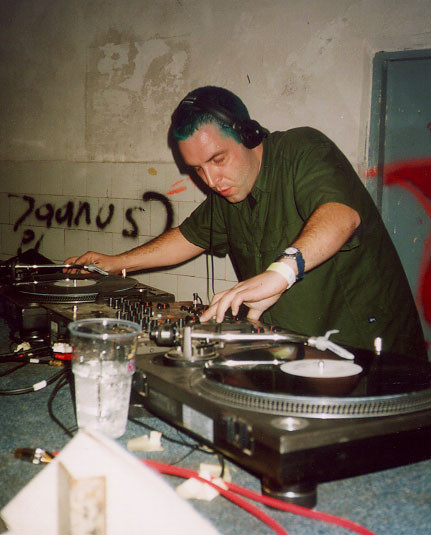
    A heavy bassline reverberates from a set of monolithic speakers. They flank headphones nestled amid dreadlocks. A figure surveys what looks to be the controls to a rocket ship – they aren’t, they’re mixing decks, but he’ll nevertheless send his passengers to space.

    Outside, in the alleyway, a psych major makes half a cigarette disappear in one pull before his mates’ bewildered eyes. It’s a double-bill demonstration of vitality and sheer will. Soon after, they head inside. The gig’s about to begin.

    Each devotee stands shoulder to shoulder before their pastor. They face forward, atop a peak of euphoria, hands raised to heaven. The scene mirrors a similar gig the week prior, and the weekend before that. It’s a sight reminiscent of Sunday service, although with more E-cigarettes.

    Drum and bass’s connotations with organised faith are many. It’s spawned an avid, mobile collection of converts that gather weekly. Each initiate seems as devoted as the last, showcasing their membership to the convent through online posting, branded clothing, and tattoos. Gareth Heta, radio DJ, music writer, and self-described drum and bass nerd, has described it like this: a community.

    Community, let alone culture, is something Christchurch residents are desperate to bring back to their central city. Over the past twenty years, the provincial town has been the scene of two out of four national tragedies. Naturally, many are eager for Ōtautahi to be the epicenter of something else for a change.

    Christchurch is informally hailed as having the highest per capita drum and bass (known colloquially as DnB) listenership in the world. When I told Gareth Heta this somewhat unbelievable statistic, he nodded his head. “That sounds about right,” he tells me.

    Right now, according to Heta, DnB is experiencing a massive resurgence in popularity, fueled by a young and devoted crowd of students.

    DnB has flowered from a long evolutionary tree, the roots of which draw from hip-hop, raga, and dub. As a genre, it’s difficult to trace, a difficulty is partly due to mixing – the process of combining two songs to make a third, unique track. To Heta, the technological aspect has
    bestowed upon DJ’s the capacity to innovate and experiment in ways few other artists can.

    This notion is demonstrated by DnB’s diversity. From the raucous heavy drops of jump-up to the warm, analog tones of liquid; each sub-genre denotes a wildly different sound and scene.

    “Drum and bass popularity comes in waves,” says Heta, explaining to me that the previous wave crested with artists like Pendulum and Ed Rush. He continues on a whistle-stop tour of the genre’s history, explaining that this first wave ended as a result of artists becoming more popular and losing their unique sound. “In shifting towards the mainstream, they abandoned the filth and lost that underground vibe that I think people just relate to.”

    Set to a rolling pace of 160-180 beats per minute, the genre’s aggressive, ominous tones construct notable barriers to entry for the uninitiated. If DnB were a religion, then the “filth” Heta mentions would be its first commandment. It’s an underground, grimy, bassface-inducing sound that separates most DnB from mainstream electronica. In short, DnB is a fast-paced genre that goes hard. To Heta, it’s electronica’s answer to heavy-metal.

    Like heavy-metal, DnB tends to attract blue-collar crowds. This tendancy could reveal why Christchurch, of all cities, is New Zealand’s unnoficial DnB capital. Since large portions of the city were flattened in it’s infamous 2011 earthquake, Christchurch’s construction industry bloomed, attracting tradespeople from all over the country.

    “Tradies love a bit of DnB ” says Christie Kimble. Christie, Jamie Moir, and Ashleigh Rangi are co-founders of Sub180 entertainment, a local DnB promoter. All three have been organising music events in Christchurch since the age of 15. They know their way around the scene like few others my age.

    Big drops and foghorns aside, drum and bass isn’t entirely devoid of warmth. By adding more vocals and adopting a distinctly analog sound, liquid DnB emerged as an answer to the grime. Artists like DJ Fresh pioneered this sound and soon found a temporary home on the charts. Today, artists like Hybrid Minds carry the torch.

    In many ways, liquid brought the genre out of the basement and into the sun. It’s whittled down the initial barriers to entry that put off those averse to dirty drops, foghorns, and big wops.

    Nevertheless, it’s DnB’s inherently grimy sound and scene that has led to the development of stereotypes.

    Like all labels, these consist of an awkward mix of fact and fiction. Tom Prayoonyuang, a founding member of the Christchurch-based DnB duo Catch 22, argues this: “the biggest misconception about DnB is that everyone just gets on the gear.” “I think it’s easy to slap that druggy stereotype on young people going to gigs” adds Ashleigh. “If you look at every professional industry there are people doing drugs. That gearhead stereotype ends up tainting our culture and I don’t think it’s entirely fair.”

    Ashleigh has a point. Recreational drug use isn’t exclusive to DnB enthusiasts. “Just look at Woodstock or Pink Floyd,” says Jamie, “I think there’s definitely a correlation, but that doesn’t necessarily mean there’s causation.”

    Nevertheless, the sordid marriage between substances like MDMA and music like EDM is well known. In the latter half of the 20th century, the mainstream appeal of both developed simultaneously. Does ecstasy make music better? Or does music make ecstasy better? Maybe both, it’s hard to tell. EDM’s open, community-centric ethos could be the result of a younger crowd that holds tolerance in higher esteem than generations prior. Or, it could result from the effects of MDMA, which makes one more social, intimate, and accepting.

    Dr. Rick Doblin, the founder of the Multidisciplinary Association of Psychedelic Studies, noted in 2013 that it’s hard to determine what functions within the EDM scene are served by substances or by the pulsing beat, lights, and crowd. Ultimately, he describes the communal dance party as a spiritual experience with a blurred line separating the euphoria-inducing chemicals produced naturally by the brain and those sold by the gram.

    It’s here, again, that the unlikely crossover between faith and DnB re-emerges. To Doblin, ecstasy-fueled EDM and religion serve the same two psychological purposes. They’re rituals that connect us to others, and they enable us to experience a heightened consciousness. Both qualities are present at the Saturday gig, neither appear inherently negative.

    Nevertheless, both Gareth Heta and Rene Bell, owner of the popular gig-hosting venue ‘The Slate Room,’ agree that there are dangers posed by substances. This is particularly true when their usage mixes with a distinctly kiwi binge culture that prioritises “going hard” on a night out. In many ways, the electrifying pace provided by DnB fuels this impulse, thus creating a positive feedback loop of chemicals and music.

    To Rene, this cocktail is enough to set business owners, such as those of the now-closed Winnie Bagoes nightclub/pizzeria, on edge. “I don’t think drugs will ever go away,” says Heta, stressing the need for more education surrounding drug safety. “Kids will always do what they want and at some point, we’re powerless to stop them. All we can do is hope we can help them get through it without too many casualties.”

    Ultimately, drum and bass is a diverse genre with a complicated relationship with the mainstream.

    Yet, at the turn of the century, Chicago bandstands were the first public places to be desegregated by custom. Fifty years later in Nashville, Elvis Presley’s hips threatened a nation’s moral fabric. Perhaps DnB in Christchurch, of all places, is the latest incarnation of boundary-pushing music that challenges the status quo? The only real way to find out for sure is this:

    Go to a gig and see for yourself

  • CANTA Magazine – Smackdown 2020

    CANTA Magazine – Smackdown 2020

    According to recent headlines, the earth could be struck by an asteroid on November 2nd, 2020. To many, this event will provide a welcome excuse to avoid having to live through November 3rd. See, November 3rd is election day in the United States. It will mark the end of a contest that began the moment the last one shuddered to a close four very long years ago.

    US politics and the upcoming election are worth paying attention to. As the world’s sole superpower, the United States holds sway over the affairs of almost every country on earth, including our own. It’s disconcerting, then, that something so crucial to our collective wellbeing is also bonkers. 

    How can one make sense of our trans-Pacific cousins? What can happen on November 3rd? 

    The answers to all these questions and more lie in a realm where distinctly American theatricality and madness are tools of the trade. The answers can be found, I would argue, in WWE. 

    Pro-wrestling and politics share many similarities. Today, on a base level, they’re essentially the same business; nowhere is this more apparent than in the presidency of Donald J. Trump. 

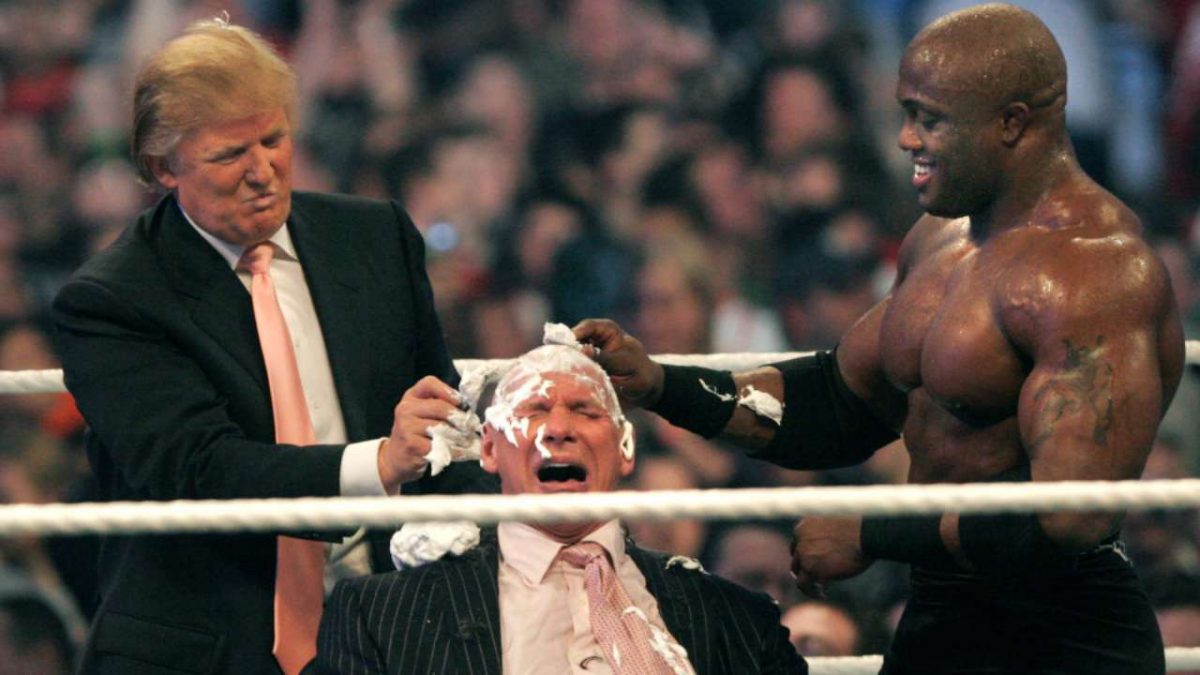
    Trump is a WWE hall-of-famer and to-date the only world leader to have been kicked in the stomach by Stone Cold Steve Austin. He’s been involved in pro-wrestling for decades. In 1988, he hosted Wrestlemania IV and V in Trump Plaza. In 2007, he faced off against WWE CEO Vince McMahon in ‘The Battle of the Billionaires.’ 

    Yet, despite their theatrical beef, McMahon and Trump are close. Eerily, their career trajectories sync. Both rose to prominence in the 1980’s, both built upon their business success with forays into the world of reality TV, they even have the same catchphrase (“you’re fired!”). Most importantly, however, McMahon and Trump owe their success to a mastery of character work – a longstanding staple of pro-wrestling.

    Wrestlers adopt personas that are, to use the industry terminology, either ‘faces’ or ‘heels’ – AKA, good-guys or bad-guys. Traditionally, a heel’s role in wrestling storylines is to antagonize the crowd. The face would then arrive and assault the heel, bringing the storyline to a cathartic if predictable end. 

    This dynamic would imply being a heel is detrimental to one’s pro-wrestling career. Far from it. Some of the most loved wrestlers of all time – Ric Flair, Hulk Hogan, Steve Austin – played heels. See, heels thrive because shocking behaviour makes for good TV. Their villainous persona gives them a lot more flexibility with what they can do or say, there’s a facet of human nature that respects that – as Donald knows all too well. 

    Consider now the pro wrestling character that is Donald J. Trump. He’s brash, boorish, rude, and rich – a typical ‘heel.’ Yet, like every other heel from McMahon to Steve Austin, it’s these very qualities that electrify his audience. Trump also creates characters out of his opponents: “Crooked Hillary”, “Sleepy Joe” and “Lyin’ Ted Cruz” to name a few. His supporters applaud when he antagonizes these personas – much in the same way audiences applauded when Stone Cold Steve Austin filled Mr McMahon’s corvette with cement at Wrestlemania 19. 

    Wrestling is less a display of strength and skill as it is of one’s ability to enchant audiences by working the mic. Hulk Hogan’s signature move was dropping his leg across his opponent’s chest. As wrestling moves go this isn’t too impressive, but few remember Hogan for his athleticism. Rather, audiences remember the vignettes that precede Hulk’s matches wherein he’d refer to his biceps as “12-inch pythons” and state, at length and in no uncertain terms, the nasty things he’d do to his opponent in the ring. 

    Donald Trump also excels at mic work. He recognises that in politics, as with wrestling, competence comes second to bluster. It doesn’t matter how many real-world blunders he makes, so long as he can talk himself up and put his opponents down, audiences will stick by him. 

    For two decades, 24-hour news cycles and the emergence of social media have reduced complex political issues to simple slogans. Multi-faceted topics surrounding race, history, and geopolitics are stripped down to fit snugly within a tweet, Instagram story, or half-hour cable news slot. The result? A feedback loop of never-ending feuds characterised by fierce rivalry, mud-slinging, and a fundamental lack of understanding or empathy between parties. In this media environment, character work and simple storytelling thrive. 

    Donald Trump didn’t construct the political climate that makes his presidency possible. His decades of involvement with WWE merely allowed him to recognise elements of pro-wrestling within political discourse and play them to his advantage. 

    All Trump did was tear away the veneer of sophistication covering what was otherwise a slugfest not far removed from the feuds settled by pay-per-view cage matches. This is how he ripped apart the competition during the Republican primaries. Why watch Ted Cruz try to act the macho pro-wrestler? With Donald, you have the real thing. 

    Pro-wrestling is simple, that’s the heart of its appeal. It provides catharsis; feuding parties gear up for a fight, have it out in the ring, the loser is faux-pummelled into submission, and everyone goes home satisfied. This won’t be the case on November 3rd, and that’s where this WWE comparison ends. 

    The pro-wrestlification™ of politics in the United States is damaging to discourse because it frames issues with a good/bad dichotomy that isn’t really there. The truth, as always, resists simplicity. Nevertheless, I’ll bet good money a wrestler is elected president within the next 10 years. 

    God, I hope it’s The Rock.